Showing posts with label Cleaning Equipment. Show all posts

Tuesday, 22 September 2015

How to Clean the Dirtiest Items in Your Kitchen - Cleaning is Important

Below are 18 easy and fast best cleaning hacks that will show you how to clean nearly everything in your kitchen -- and beyond:
  1. Inside the Microwave
    "Steam lemon juice or white vinegar. Let the steam sit, then wipe everything off," Reichert suggests. "The acid in the steam removes built-up food." But even heating plain water works, too.
    microwave oven clean
     
  2. Greasy Baking Sheets
    Jill Nystul, a journalist-turned-blogger at One Good Thing by Jillee, uses baking soda and hydrogen peroxide for baking sheets, stove burner pans and her flat iron. She sprinkles on baking soda, pours on a little peroxide, sprinkles on more baking soda and waits at least two hours. After that, you can practically just wipe it clean!
     
  3. The Oven
    "One of my least favorite cleaning tasks in the kitchen used to be the inside of the oven," says Nystul. "Scrubbing stubborn, greasy messes is hard enough without having to climb inside your oven to do it!" She puts a shallow dish with a cup of ammonia on the top rack, and a pot of boiling water on the lower. Let it sit overnight. In the morning, the mess wipes clean.
     
  4. Plastic Melted on a Toaster Oven Window
    Use a straight-edge razor at a 45-degree angle to remove it.
    microwave oven clean
     
  5. Waffle Iron
    A knife wrapped in a napkin gets inside ridges without scratching the surface.
    Waffle Iron Clean
     
  6. Coffeemaker
    Run water mixed with white vinegar through the system, then run plain water through twice more. Carefully scrub inside the pot with ice cubes and salt.
    Coffeemaker clean
     
  7. Humidifier
    Run white vinegar through the system. Once you smell vinegar in the air, turn it off and let it sit overnight so the acid kills the bacteria. In the morning, run plain water through the system until the vinegar smell is gone.
    humidifier clean
     
  8. Fingerprints on Stainless Steel
    "The reason stainless steel appliances get fingerprints is that they are oxidizing," says Reichert. Scrub the area with a gentle scrubbing powder or baking soda, then rinse. "To keep it clean, use a microfiber cloth."
    stainless steel clean
     
  9. Tile Grout
    Using an old toothbrush, scrub grout with a paste of hydrogen peroxide and Borax.
    tile grount clean
     
  10. Kitchen Walls
    Reichert wipes food grease off walls with a rag dabbed with rubbing alcohol to cut grease and oil. Since it's flammable, make sure there are no open flames when you clean! "If it's been there a while, you can mix alcohol with baking soda," says Reichert. "The alcohol cuts grease -- the baking soda scrubs the stuck-on spots."
     
  11. Carpet Stains
    Dab a little club soda on the stain. If that doesn't work, spray hydrogen peroxide mixed with water to lift stains, then absorb with a clean towel.
    carpet stains clean
     
  12. Kitchen Trash Can
    Take it outside and spray it with a hose, preferably before it starts to smell, then let it dry outside. Use a baking soda paste on caked-on dirt before spraying.
     
  13. Stained Pan Bottoms
    Use a mixture of salt, Borax and baking soda with a Mr. Clean Eraser sponge.
    stained pan clean
     
  14. Stained Countertops
    Scrub stains off counters with a whitening toothpaste.
    stained countertops clean
     
  15. Cast-Iron Skillet
    Don't use soap! Soak the pan in water, then scrub with a chainmail scrubber. Scrubbing tough spots with a plastic scrubber works, too.
     
  16. Mirrors and Windows
    For streak-free cleaning, use a fine woven microfiber cloth, such as an eyeglass cloth.
    mirrors and windows clean
     
  17. Range Hood
    Lots of kitchen surfaces get coated with residue that's hard to clean. Nystul swears by fighting oil with oil! She pours a few drops of oil (any kind!) on a microfiber cloth or paper towel and wipes the gunk right off.
     
  18. Any Surface
    Mr. Clean eraser sponges clean fiberglass, stainless appliances, countertops, tables, walls -- even the kitchen sink -- without stripping the surface or leaving residue.

Saturday, 19 September 2015

Few things to look for when investing in a vacuum cleaner - Astol Cleantech Pvt. Ltd.

1. Suction power: Essentially, vacuum cleaners work through suction that is created by a built-in motor. The stronger the motor, the stronger the suction power it creates, and the more efficient the vacuum cleaner will be at sucking up all the dirt and dust. “When choosing a vacuum cleaner,” “be sure to take note of its power levels. All Astol Cleantech vacuum cleaners have very powerful motors, ranging from 1 600W to 2 200W depending on model, but this by itself does not guarantee top performance. What is important is that the power is used effectively throughout the system - from the floorhead and the hose, right through the filters and the dustbag, to give maximum suction. And to do this, all parts of the vacuum cleaner must work together to create an optimum flow of air.”


2. Manoeuvrability: Consumers often overlook manoeuvrability; however, good manoeuvrability is one of the most important features a good vacuum cleaner can have. “Having a vacuum cleaner that is easy to get around is essential – it needs to be easy to move to make light work of cleaning, and it needs to be able to get into difficult-to-reach and small areas. Look for wheels that have a 360-degree swivel – the undercarriage of Astol Cleantech vacuum cleaners for example, has three high quality, smooth running castors, making the cleaner extremely stable and very easy to guide around obstacles and over thresholds. The cleaner can also sit upright, making it very convenient for use on stairs. Astol Cleantech latest range of vacuum cleaners – the S8 range – boast DynamicDrive castors that rotate 360 degrees, have steel axles and feature shock absorbers – the rubberized wheels glide smoothly, are gentle on floors and are wear-proof

3. Simple operation and noise levels: Nobody wants to spend hours trying to figure out how to switch the vacuum cleaner on, “Vacuum cleaners should above all, be simple to operate – offering easy functionality to even the most technologically-challenged individuals. Over and above this, its special features should be easily accessible so that it makes the job of vacuuming much easier, not more complicated.

4. Compact and lightweight: Buying a compact cleaner often means making compromises such as accepting poorer quality, less efficient dust pick-up or inferior filtration. That most of us do not want to cut corners when it comes to the cleanliness of our homes or the quality of the air we breathe, but we still want a compact and lightweight vacuum cleaner that is easy to store.

5. Aesthetically good-looking: Today’s appliances don’t just have to be functional, but they should boast good looks as well. Astol Cleantech vacuum cleaners are convincing through their clean and modern lines, and they boast a high level of visual detail. With a combination of fresh, contemporary and classic lines, as well as high-quality surface refinements, each Miele vacuum cleaner is an attractive appliance in its own right.

6. Environmental sustainability: With environmental friendliness being a hot consumer trend at the moment, and with the ever increasing cost of electricity, it is very important to take into account how energy efficient a vacuum cleaner is, “In line with Astol Cleantech cradle-to-grave approach to environmental sustainability; all its vacuum cleaners boast energy-optimised motors that set the benchmark in energy efficient vacuum cleaning. Another thing to look at is the overall carbon footprint of the vacuum cleaner – as with all of Astol Cleantech appliances, its vacuum cleaners are designed, manufactured and tested to last for 1 000 operating hours. 

7. Longevity: It is very important to take into account how long your vacuum cleaner will last for – you may pay more for it initially, but if it is built to last, you will save money in the long run. When it comes to quality, we at Astol Cleantech are confident that nobody tests as diligently as we do. For any parts and components to be included in a Astol Cleantech products, they have to meet very stringent quality requirements and prove that they will endure 20 years of average household use.

- From hard floor to carpet: Check for a footswitch tat is used to gently lift the front of the electrobrush, so you can easily move from a hard floor to a rug.
- Automatic height adjustment: The bristles under the electrobrush should be spring-loaded to effectively clean different depths of carpet pile.
- Swivel neck: A unique swivel neck joint allows for navigation around furniture, and for it to be rotated for easy cleaning around obstacles such as table legs.
- Ergonomic carry handle: Check for an extra ergonomic carrying handle at the back that will allow the user to easily lift the cleaner and carry it upstairs.
- Large dustbags: Large dustbags facilitate the cleaning of large areas.

Thursday, 30 October 2014

Pressure Washers - Cleaning Machines

Pressure washers are a vital tool in the industrial environment ensuring that cleaning is carried out to the standards and regulations required. The pressure washer has been around for many years and has developed into a wide range of types. The basic principle is the same in that water is fed into a machine and is the pumped out via a lance, exiting through an adjustable nozzle. The spray can be altered by adjusting the nozzle to suit the cleaning job in hand, the narrower the water jet the stronger the cleaning force, but less area is covered.

Selecting a Pressure Washer

Selecting the correctly sized machine from the huge range of pressure washers available can be daunting. The selection criteria are based on the type of job the appliance is required for. An example would be oil or greasy deposits which are adherent may require a high pressure to remove them, however a large hard surface area requires a lower pressure but a higher water volume. Consideration should always be given to the duty that the machine will be required to give to make sure you select the correct machine.

Types of Pressure Washers

The sophistication of pressure washers has developed over the years and there is a lot of choice. Hot water washers as well as cold are now available which are more effective if degreasing or disinfecting are required. The other advantage is that because hot water cleans better than cold, lower pressures can be used. Pressure washers can be portable or static and there are advantages to both:

  • Portable Pressure Washers have an advantage as they can be moved where the cleaning is required. If the washer powered by electricity the portability is obviously restricted by the length of the power cord. Some pressure washers are available with their own power source, such as a diesel engine and can be moved around the site or off site for remote cleaning.
  • Static Pressure Washers are a static wash system for premises where there is a regular requirement for hot water pressure cleaning. This would useful say in a transport company where a static jet wash facility could be used by a variety of operators at different times or in a small food processing plant where a cabinet mounted pressure washer would enable efficient cleaning. This type of stand alone hot pressure washer can be attached to a ring main system for one or two operators to access at various points to clean around the premises.
For information about pressure washers and how they can help you keep your business spotless, contact Astol Cleantech (P) Limited for the best advice and prices available.

Tuesday, 28 October 2014

Cleaning Equipment - Vacuum Cleaners

The range of cleaning equipment available for cleaning the industrial environment is large and varied. There is equipment to assist in all areas and can achieve levels of cleanliness and hygiene in a remarkably short space of time, resulting in less downtime and a more efficient use of resources

Types of Cleaning Equipment - Floor

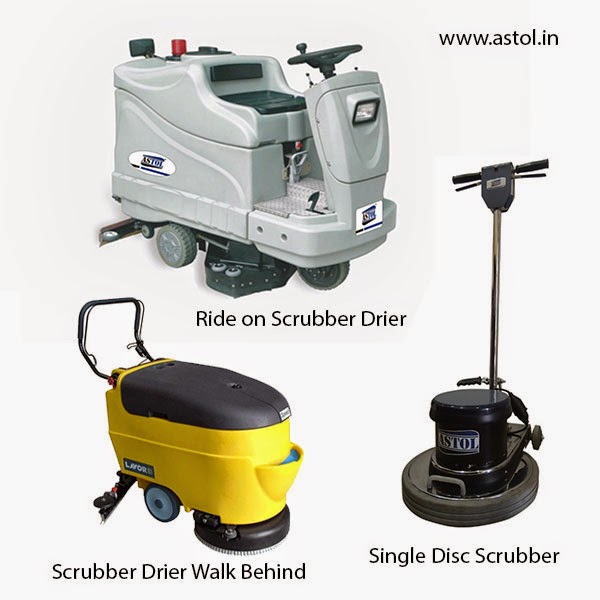
Floor cleaning is a job that has to be done in all environments large and small, and there is a machine for every task. For instance the vacuum cleaner can do more than clean carpets, being available in models that can remove wet or dry residue, or even deal with hazardous dust. The floor sweeper is quite a familiar sight in commercial premises, and mechanically replicates the action of manual sweeping. The dirt is swept back under the machine by the leading rotating brush and swept further by a horizontal brush, back into a collection vessel. There are a variety of configurations and sizes to suit all applications, and to achieve the optimum results. For more adherent deposits there is the scrubber dryer, which is similar in appearance to the floor sweeper but fulfils a different function. This machine also uses a leading rotating brush but also applies a detergent solution and literally scrubs the floor. The resultant residue is then removed by a system of squeegees to leave the floor dry. Both sweepers and scrubber dryers can be pedestrian operated or ride-on depending on size. Basically there is a floor machine for every type of surface and every type of deposit.

Other Types of Cleaning Equipment

Industrial processes are by their nature prone to create dirt and pollution within the workplace and outside; sometimes the dirt and pollution is created by the public (for instance graffiti); but it all requires an efficient clean up. The development of the pressure washer over the last 40 years has improved the ability to remove stubborn dirt and to do it in a shorter time (it is particularly useful in the field of graffiti removal). Pressure washers may use hot or cold water; cold for general grime but for stubborn stains or degreasing then hot water is better. The amount of pressure used to impel the water is important as too high a pressure could damage the surface being cleaned, yet too low would render the washer less effective. A pressure washer can be portable or static. The portable washer has the advantage of being able to be moved around or even off site, however, if the cleaning is part of a regular process, a static cabinet mounted pressure washer could be better as it is always in position ready to go and geared to the job in hand. For instance a pressure washer could be used as a static jet wash in the transport industry or as part of a centralised cleaning system where a number of operatives can use the pressure washer at the same time by using a ring main system.

For more specific and hygienic cleaning, then a steam cleaner may be the answer which as with the pressure washers these can be portable or static.

To find the right solution to your cleaning problem talk to people who know, like Astol Cleantech (P) Limited who have a wealth of experience in the cleaning equipment industry and have great advice and products at good prices.

Friday, 26 September 2014

What is a pressure washer? - Vacuum Cleaner

A pressure washer is a mechanical device that uses a pump to generate a high-pressure stream of water to clean surfaces. The pump is typically powered by a gasoline engine, an electric motor, or a diesel engine. The pump is a positive displacement pump that forces a specific amount of water flow from the outlet.  By restricting the flow with the nozzle, much like you do by placing your thumb over the end of a garden hose, the pressure washer produces pressure. Without the nozzle the impact of the water from the end of the pressure washer hose is similar to that from a garden hose. The narrow diameter of the nozzle increases the water's velocity and, consequently, its impact and cleaning power. The smaller the nozzle orifice, the more pressure is potentially produced. However to produce greater pressure, more horsepower is required to force the water through the smaller hole. Each pressure washer calls for a specific size nozzle to match the flow of the pump and the horsepower of the motor. Putting too small a nozzle on your pressure washer strains the components and may cause excessive wear to the machine; too large a nozzle sacrifices cleaning power.


All pressure washers produce pressure and flow. Both are important to the cleaning process. Most pressure washers also provide a method for dispensing soap or detergents, either under low or high pressure. The proper use of soap is often key to the cleaning process. Hot water pressure washer are equipped a burner system to continuously heat the stream of water, further aiding the aiding the cleaning process. Most hot water pressure washer can generate wet steam of approximately 240 degrees F, by turning down the pressure to around 150 PSI. There also true steam cleaners that generate a dry steam of approximately 320 degrees F at 150 PSI. Understanding the basic concepts of pressure flow and cleaning units will help you pick the right pressure washer for the cleaning job at hand.

Pressure and flow
Pressure washers use the impact of the water to break the bond of the dirt to the surface you are trying to clean; the higher the pressure, the greater the impact. The type of nozzle you use makes a huge difference in how much impact your pressure washer creates. A zero degree tip gives you the full impact of your pressure washer but is almost useless for cleaning because it hits such a small area. A 15 degree nozzle increases the area you can clean at one time, but reduces impact by 70%. A 40 degree increases the surface area cleaned further, but has 88% less impact than a zero degree nozzle. This is why a turbo nozzle is so effective; for it is a 0 degree nozzle rotating thousands of times a minute creating a 25 degree cone of full impact.
The amount of water, or flow, a pressure washer puts out makes a big difference in cleaning. The flow is what carries the impact to the surface. The more flow, the more impact; there is a direct relationship. A 13 HP pressure washer putting out 4000 PSI at 3.5 gallons a minutes flow has one third less impact than a 20 HP unit putting out 3,500 PSI at 5.0 gallons per minute. Moreover, flow is what is needed for effective rinsing. This is especially true when cleaning large open surfaces, like driveways; or quickly rinsing vehicles in truck washing operation.

Cleaning units
A pressure washer pump creates a positive water flow, and by restricting that flow at the nozzle creates pressure. The more horse power driving the pump allows more flow to be pushed through the pump and the more pressure to be created at the nozzle. For a given amount of horsepower you can have only so much pressure and flow; there is a tradeoff. Most people focus on pressure (PSI), but you really need to consider both pressure and flow. One way of comparing pressure washers is to use the measure of “cleaning units”. To calculate cleaning units, multiply the pressure times the flow of the pressure washer. All other things being equal (i.e. chemical use and heat) a unit with higher cleaning units will clean better than a unit with lower cleaning units.

Cleaning unit application guidelines
Home use, light duty: 2,000 to 3,750 cleaning units.
Medium duty: 3,800 to 7,500 cleaning units
Heavy duty: 7,600 to 15,000 cleaning units'

The measure of cleaning units is a good way to compare the power of one pressure washer relative to another, with the following proviso. When two pressure washers have different pressure and flow specifications, but the cleaning units are equal, remember the unit with the higher pressure unit will make a rotary nozzle work better, while the higher flow unit will rinse better and make flat tip nozzles work more effectively. With that in mind, the following guide can be used on how much pressure and flow is needed to perform certain tasks. Some of these tasks may require a rotary Dirt Killer nozzle as well if you are using the minimum PSI. The minimum specifications are what are required to get the job done. Having more pressure and flow will make the job go faster. The column marked preferred CU shows how much cleaning power is required to get the job done more quickly. (CU means Cleaning Units: cleaning units = Pounds per Square Inch of pressure (PSI) times Gallons Per Minute of flow (GPM).

Tuesday, 23 September 2014

How does a pressure washer make things clean? - Pressure Washer Cleaners


Understanding the cleaning process is essential to the effective use of a pressure washer. A pressure washer cleans by creating a high pressure stream of water that hits the surface with a large amount of kinetic energy, thus removing the dirt mechanically, while providing a constant flow of water to wash the dirt away. Often dirt is mixed with grease or oil, or other substances, which chemically bond the dirt to the surface you are trying to clean. Sometimes even the force of high pressure water needed to break these chemical bonds is insufficient to get the surface clean without requiring excessive pressure, that is either impracticable or would damage the surface. Adding a detergent, or other cleaning chemical, or using hot water, while agitating or brushing the surface, significantly enhances the cleaning power of the pressure washer.

Detergents and soaps are used for cleaning because pure water can't remove oily, organic soiling. Soap cleans by acting as an emulsifier. Basically, soap allows oil and water to mix so that oily grime can be removed during rinsing.

Detergents cannot accomplish much until some mechanical energy or agitation is added into the equation. This mechanical energy is provided by the pressure washer. As the detergent emulsifies the grime, breaking the chemical bond, the blasting effect of the pressurized water strips the dirt from the surface, while the flowing water rinses the detergent and soil away. Warm or hot water, or steam, melts fats and oils so that it is easier for the soap or detergent to dissolve the soil and pull it away into the rinse water.

Tuesday, 16 September 2014

How to Maintain the Carpet on Your Staircase

A carpeted staircase adds color, texture, and extra tread for safety on stairs. While you can cover the carpet with plastic runners to protect it from gathering dirt, that is an unsightly solution that should only be temporary. Follow this advice to give the carpet on a high-traffic staircase some special attention to keep it looking new and clean.


Step 1 - Have the Right Vacuum

Just like the carpet in the rest of your home, the carpet on your staircase needs regular vacuuming. It removes dirt, tiny bits of gravel, and debris from the rug that can grind away at it and do damage over time. A standard vacuum cleaner really isn't designed for stairs. It can be heavy to carry and too big for the small steps, making it almost impossible to use properly.

To vacuum the stairs, invest in a lightweight, handheld model that's about the size of a small suitcase. It should include different attachments. You can hold the main unit in one hand and guide the attachment with your other. When vacuuming stairs, always remember to start at the top and work your way down.

Step 2 - Use a Brush Attachment

A hose is good for sucking up surface dirt and may even get some deeper dirt that's loose in the pile. For the best results, use the brush roller attachment, which is similar to the beater brush on your standard vacuum. Doing so loosens impacted dirt and can help your carpet last longer.

Step 3 - Get a Stiff Broom

A stiff broom is also helpful for cleaning your carpeted staircase. It is much more lightweight than any vacuum. Doing so will improve the appearance of the carpet, but vacuuming is still recommended for a deep-down clean. To sweep the carpeted staircase, start at the top and move down. Sweep each step until any debris is on the bottom floor and can be vacuumed or swept away.

Step 4 - Steam Clean

You can steam clean the carpet on your staircase just as you can any carpet. You'll need a steam cleaner with a handheld hose attachment to do this. If you don't want to purchase a steam cleaner, you can probably rent a machine from a local grocery store. Keep in mind that investing in a home steam cleaner will save you money over time.

Step 5- Hand Scrubbing

You can also opt to shampoo the carpet by hand. It is also the best method of spot-cleaning. Some stains, like those with oil bases, may require a pre-treatment solution that loosens the dirt so it can be lifted from the carpet fibers.

Mix specially formulated carpet shampoo with water until you get a light foam. Work it into your carpet with a scrub brush. If you have a Shop-Vac or other wet/dry vacuum, vacuum as much water as you can out of the carpet. Otherwise, use a soft, absorbent towel or cloth to blot the carpet and remove as much water as possible. Once the staircase is completely dry, go over it with a vacuum.

Tuesday, 15 July 2014

Cleaning, Sanitation in Food Industries

The primary objective of cleaning in Food Industry is to remove the residue in the machinery on which bacteria grow and to rid all the surface areas including walls of any physical impurities. 

Efficient methods

 The most popular and often used method to remove surface deposits is to clean with a Pressure Washer of about 15 lpm flow & 150 bar pressure. The size and type of pressure washer will be determined by the area and type of machinery being cleaned and the level of cleanliness required. The type would normally be a hot water pressure washer with a steam nozzle option for deeper cleaning like ‘HOT WATER MODEL – 6970’ from Astol Cleantech (P) Ltd.


Alternatively, a standalone Dry Professional Steam Cleaner generating about 9– 2 bar steam pressure might be more appropriate for some applications. This cleaning equipment is available as static or portable unit but the selection of the correct unit is determined by the requirement of the equipment used in the process. A preferred one shall be a Mobile Unit for its convenience to be carried to the point of use – the applications surfaces. Model steam cleaner supplied by Astol Cleantech is ‘GV KATLA.’ 

Customized Cleaning


The processes followed in food industry are normally same every day and therefore, the cleaning requirements are also more or less likely to be similar. The procedure for cleaning food industry machinery is to clean surfaces with the appropriate chemicals followed by rinsing and applying a sanitizing agent to reduce microorganisms to a safe level. To achieve the correct level of hygiene, it is better to install a customised system which allows the process to be carried out to the correct standard. - See more at: Click here


Thursday, 10 July 2014

Selecting the right Floor Scrubber

Cleaning floors in theindustrial or commercial environment has to be done regularly because of both hygiene and safety. We have many things to thank gravity for, but as far as any floor is concerned it makes every unwanted speck of dirt or spillage locates itself on top of it. Fortunately cleaning the floor is not as onerous as it used to be thanks to the wide range of industrial cleaning machines now available which saves time and effort (imagine cleaning a floor with a mop and bucket!) One of the most useful machines is the floor scrubber which not only cleans the floor but dries it as well.


How it works

The floor scrubber imitates the action of manual scrubbing by using mechanically driven brushes or pads which rotate to agitate a detergent solution into the floor. The resultant dirty residue is then collected by a system of squeegees at the back of the machine and vacuumed up into a storage tank in the machine for later disposal. This process not only cleans the floor but leaves it dry enough to be used normally after cleaning. Floor scrubbers come in a wide variety of sizes and configurations, from a small push along machine for small areas to a powered ride-on version for cleaning large areas, and there is quite a range of different floor scrubbers in between!

Some things to consider before choosing a floor scrubber to buy or hire
  •  What types of surfaces will it be required to clean? Concrete, tiled surfaces, wood or even carpet will need machines with the right attachments.
  •  Is the noise level of the machine important? If the cleaning is to be done in working hours or in a public area, the noise level will be a significant factor.
  • How tough is the machine? A floor scrubber used in a commercial or industrial environment will typically take a few knocks. Can it stand up to it?
  •  Is the machine well designed for operator use? A poorly designed machine can make using it unnecessarily difficult and can lead to operator fatigue which is not only bad for the operator but also interferes with the effective cleaning.
  •  Are the controls straightforward to use? Using a floor scrubber should be able to be done by anyone with the minimum of training
  • Can spares be readily supplied? All machines with moving parts will need maintenance at some time and things like brushes and pads wear out and need replacing. Check to make sure there won’t be a problem in the future.
  • How manoeuvrable is the machine? You want the scrubber to clean all the floor area and that may include some more out of the way areas with limited access, make sure the machine will do what you want it to.

These are some of the criteria to consider before buying or hiring a floor scrubber. 

Know more: click here

Thursday, 3 July 2014

Buying guide for floor cleaning equipment

Some things to consider before buying or hiring floor cleaning equipment:
  •  Think about what types of surface (or surfaces) are to be cleaned. If there are different surfaces will a single machine be able to cope?
  •  The physical size of the cleaning area determines the size of machine needed. The cleaning width of the floor sweeper or scrubber dyer will give an indication of how much cleaning can be done, and most machines give a floor area performance indication in their technical details to show the area that can be cleaned in an hour.
  • The power source is important – mains, rechargeable battery or engine powered. The type of motive power is determined mainly by the physical area being cleaned, for a smaller area a mains powered machine is probably adequate, but the complication of a trailing lead becomes more significant, and potentially hazardous, in larger areas where battery power would be better.
  • The type of dirt or debris being removed should also be considered. Light dust or deposits will require a machine of different duty than oily or hard to remove dirt.
  • An industrial floor cleaning machine is often used in an environment where it can be subject to knocks and bangs so robustness is important to ensure good service and machine longevity.
There is much to think about before buying floor cleaning equipment and before buying it might be an idea to hire a similar machine to make sure it is the right type for you purposes. Because of the complexity and variety of these machines it is advisable and obvious really, to get advice from a reliable source in order to make an informed decision, as it is a significant financial commitment.

Sunday, 29 June 2014

Buying Floor Cleaning Equipment

There is a lot of floor cleaning equipment available to buy or hire, fulfilling different functions within a business’ cleaning regime. Things have moved on significantly from the simpler times of the broom or the mop and bucket, and now there are a plethora of sophisticated floor cleaning machines available to those managing commercial facilities. So what sorts of machines are there? And what should you look for before buying.

Types of floor cleaning machines

Floor Sweepers

The floor sweeper is a machine often seen in factories and warehouses, and effectively replicates using a broom, but there is much more to it than that. Using rotating brushes the floor sweeper effectively sweeps the dirt from the floor and deposits it into a hopper for emptying at a later date. These machines are available as pedestrian, where the operator walks behind the machine and pushes it along, and as a ride-on version where the operator actually drives the sweeper, which is more fun!

Floor Sweepers


Scrubber Dryers

As the mechanical floor sweeper imitates the action of using a broom; then the scrubber dryer replaces the mop and bucket in the modern workplace. Similar in appearance to the floor sweeper, the floor scrubber uses its brushes to agitate cleaning solution into the floor to remove the dirt and the resulting residue is the collected by a system of squeegees at the rear of the machine. This residue is then vacuumed into a collection tank for later disposal. The floor should be left both clean and dry which means the minimum of disruption to the business. Like the sweeper the scrubber dryer can be a pedestrian or ride-on model.


Scrubber Dryers


Floor Buffers and Polishers

Floor buffers are versatile floor cleaning machines capable of polishing various types of floors including wood or stone and some heavy duty machines are also capable of scarifying concrete floors. The machine pads can be changed to suit the job in hand such as cleaning or polishing.


Floor Buffers and Polishers

Know more to our experts: click here

Wednesday, 25 June 2014

Benefits of Single Disc Scrubber Machines

Single Disc Scrubber Machines are known to provide the best cleaning results compared to any other machine. They are one of the least expensive machines with a wide array of tasks that can be performed with a single machine with just the right change of brush or pad. The single disc scrubber essentially replicates the human action of cleaning, by using a rotating disc, which is in contact with the floor to scrub, buff and polish the area as required. Just that it employs more pressure and speed to clean the floors faster and with greater efficacy compared to manual cleaning. Single disc scrubbers are compact and most easy to be transported via smaller vehicles or public transportation systems to various sites with minimum damages and transport hassles. This makes it a favourite for the in-and-out service job industry people who provide carpet shampooing, marble/ granite polishing, residential spring cleaning services and 1-time cleaning services in offices or small workshops. Single Disc Scrubbers are preferred also because they:

  • Reduce recurring labour costs as lesser number of manpower will be required for cleaning a given area
  • Reduce training and labour turnover costs
  • Improve quality and consistency of cleaning
  • Increase productivity and efficiency by speeding up the cleaning process
  • Maintain level of hygiene and
  • Increase safety standards


Single disc floor scrubber is the single most important machine for the hospitality industry along with the vacuum cleaners. Be it hotels, hospitals, housekeeping service providers or specialized service providers like carpet shampooing and floor polishing, the single disc scrubber has served these segments sincerely and provided its users with generous profits. Every hotel from a 1-star hotel to a 5-star hotel, we can find a single disc scrubber being used, whether it is for marble polishing, carpet shampooing, floor cleaning, wooden floor sanding, buffing etc. Hospitals and laboratories frequently need single disc scrubbers to revitalize the floor polish that has been applied. They can also be used for cleaning under the beds as larger scrubber dryers cannot reach into such compact spaces.

Even in engineering industries where the layer of muck (oil or grease from machines that sticks with dirt to form a sticky layer on the floor) is large enough to make the floors look very dirty with uneven muck deposits, single disc scrubbers can be used with wire brushes and appropriate degreasing chemicals and the original floors can be restored to their earlier glory. This process of cleaning is called scarification.

Even as the market for larger machines is growing at a rapid rate, single disc scrubbers will never fall out of contention and will always be the highest selling floor maintenance machine across the world. Their versatility and ability to perform newer maintenance tasks by using newer accessories always helps in getting new clientele. As the boundaries of service providers are increasingly becoming blurred, an altogether new segment has emerged, of civil contractors who are into floor polishing activities and use the conventional Frankfurt machines. With each passing day, more and more such contractors are impressed by the benefits of using single disc scrubbers combined with diamond polishing pads for floor polishing and have adopted this technology rapidly.

In fact, their demand for heavier range and duty machines in single disc category has lead to the development of larger machines with higher motor powers and heavier weights. Floor polishers across the world now prefer to work with single disc scrubbers.

Variable speed machines instead of single or 2-speed machines are being favoured. The hospitality industry feels that with multiple floor and carpet maintenance operations to be performed, it is ideal to keep one machine with variable speeds instead of different machines with different speeds. Around 10-15 years ago, not many could have envisioned that single disc scrubbers would be used with diamond pads for grinding and honing of stone floors.

See more

Sunday, 22 June 2014

Facts of Single Disc Scrubber Machines

Single disc scrubbers are the most versatile, multipurpose and general machines for maintenance and cleaning of all types of floors and carpets. As the name implies, it uses a single rotating disc which works on the floor to clean it. Different pads, rotation speed and motor power can provide the solution for any floor cleaning application: floor cleaning, scrubbing, polishing, marble/granite restoration, crystallization, buffing, spray buffing, scarifying, scouring, sanding, stripping, carpet shampooing, wooden floor sanding etc.


Theoretically, a single disc floor machine is a low speed machine with a horizontally rotating head attached to a large, round scrubbing pad or floor scrubbing brush which spins in a circle in one direction. The spinning of the pad or brush is powered by a small motor, ideally mounted directly over the centre of the machine head to distribute equal pressure on all sides of the brush or pad for proper scrubbing. Most scrubbers come equipped with solution tanks that can squirt floor cleaning solution directly into the scrubbing pad and onto the floor. Scrubbers are made to spin at a variety of speeds. The speed at which the pad or brush rotates directly affects the kind of floor cleaning job to be done.

Single disc scrubbers operate in a side to side or “swing” motion and are designed to handle scrubbing jobs, when the floor has in-ground dirt. Depending upon the accessory chosen, these machines can be used to remove old polishes from worn out floors or grind floors to bring a mirror shine finish on the same floors. Single speed scrubbers usually rotate at output speeds from about 150 to 175 revolutions per minute (RPM). Dual speed scrubbers will go from about 150-350 RPM. With new forms of engineering technologies coming in, many manufacturers have started producing variable or multiple speed floor scrubbers in which the brush/ pad speed can be regulated to suit the floor/ carpet maintenance operation being performed.

Single Disc Scrubbers


Criteria for Selection

The selection of a floor cleaning machine firstly depends upon many factors such as the cleaning operation that needs to be performed, dirt or stain prevalent on the floor, the area to be cleaned, the layout of the area, manoeuvrability of the machine to perform cleaning operations and presence of human traffic during cleaning hours. Usually, where no other machine can be suggested, a single disc scrubber can be the most general purpose machine to be used for any floor cleaning operation. The mechanical action of the floor cleaning process takes into account factors such as motor power, brush speed, brush orientation, weight on the brush and brush aggressiveness. Single disc scrubbers can be evaluated based on the following factors:

  • Motor Power: This defines the strength of the motor to rotate the brush. As the situation becomes more difficult for the brush to rotate, higher should be the power of the motor. For example, for someone doing marble crystallization or dry buffing or carpet shampooing, the friction caused between the floors and pads is higher than the routine floor cleaning operation thereby obstructing the pad to move smoothly. In such circumstances, the motors with higher power will facilitate the pad or brush to rotate despite the resistance provided by the floors. Also, if the operation hours are longer, higher motor power will be more helpful.
  • Brush/ Pad Speed: Every floor or carpet maintenance operation can be optimized with the ideal brush speed of the machine. For those who need to perform multiple operations, there are options of using single speed, 2-speed, 4-speed and variable speed machines.
  • Drive: Usually, the motors rotate at a speed of 1440 RPM, but the brush or pad cannot be allowed to rotate at such high speeds for operator safety. Between the motor and the brush, there is always a speed or motion transmission system, which is usually a gear drive or a belt drive. The more the speed reduction ration, higher is the power transmitted to the machine from the motor. Machines with belt drives are the easiest to design, comparatively cheaper, noiseless and easy to replace. However, since they are not able to produce lower speeds and transmit more power to the brush, they are more suited for easier applications like floor cleaning. For other operations such as carpet shampooing, crystallization, scarifying, marble restoration etc, gear driven machines are most suitable. With gear drives, the speed reduction ratio is higher; therefore the force transmitted to the machine from the motor through the gear drive is higher. Gear drives can also be of different types and planetary gear drives are known to transmit maximum power to the machine.
  • Brush size: If the area to be cleaned is too large, a smaller brush will take too long for cleaning and will render the cleaning job highly inefficient and time consuming. It will be a waste of the labour and money. Therefore, selecting the machine with the right brush size is most important. Most machines are available in 12”, 15” 17” and 20”. It is suggested that machine should be chosen of such a size which would support floor pads which are of fixed sizes as well.
  • Weight and stability: Although single discs require operator skills to balance rather than lift it, weight still plays a crucial role for the machines. Brush pressure is important as the right kind of pressure applied on the brush or pad can optimize the cleaning result. Machine weights should be kept as low as possible without compensating the application. Higher weights can cause operator fatigue when working for longer hours. For carpet shampooing for example, higher weights are not advisable as the extra weights may not let the pile of carpets stand up. But when grinding needs to be performed on the floors, with higher weight, the grinding results will be faster, better and more uniform. If the motor is mounted on the centre of the base of the machine right above the centre of the brush, then the pressure distributed on the base will be equal on all sides. This will help in uniform cleaning, polishing and grinding results and better stability of the machine thereby causing lesser fatigue to the operator.
  • Vibration: At higher weights or higher speeds also, the machine should be stable and should not cause vibrations. The machine operator could benefit from a lower level of vibrations – enabling the machine to be used for longer periods with minimum operator fatigue.
  • Noise: Many single disc cleaners also enable the cleaning process to blend more into everyday working practices by offering a far lower noise option than many other types of floor cleaning machines. This ensures that floor cleaning tasks are able to be undertaken during working hours with minimal disruption to the surrounding workforce and therefore reducing the cost of the machine operators’ overtime or out of hours allowance.
  • Accessories available for use with the machine: The machine should be compatible with all types of accessories so that it can be used for various applications. Except for the pads, most brushes for the machines are to be supplied by the manufacturer of the machine itself. Therefore, it should be checked first as to what are the accessories that will be provided with the machine and optionally.
  • Availability of spares and services from the supplier: Spares and services should be readily available, as longer down times for the machines means loss of revenues to the service providers. Doing a background check for availability and cost of spares will always be helpful in the smooth operations of the machines in years to come.
  • Reputation of the manufacturer: Every manufacturer in the market has certain products which are their core strengths and some products that are only to complement their product portfolio to make it an all round package. But if they are not known to supply some machines with the same quality they are usually associated with, their single disc scrubbers can be avoided.

See more: http://www.astol.in/

Wednesday, 11 June 2014

Pressure Washing Techniques For a Deep Clean

While the success of many household cleaning tasks simply depends on choosing the right cleanser for the job, there are some cases where the labor involved in removing a film or stain is just too much. Perhaps the stain is bound too tightly to the surface of what you want to clean, or the affected area is simply too large for vigorous hand scrubbing to be a viable option. If this scenario sounds familiar, your solution might require a bit more power.

Common Pressure Washing Situations
You may have seen professionals pressure washing, or maybe even done it yourself. For handling enormous cleaning tasks like buildings, walls, parking areas, heavy equipment, or even statues, a pressure washer is often the right tool for the job. Pressure washing is the preferred cleaning method for removing pollution and fuel emission residue on structures in urban areas. It is also an excellent method of removing mineral, lime, and hard water deposits. Homeowners, especially those who like to work on their own cars, will find that pressure washing is great for grease and oil stains in the garage or driveway; it can even remove graffiti!
DIY vs. Professional Pressure Washing
There is most likely a home improvement center or hardware store in you area that will rent you a pressure washer (or at least point you in the right direction to find someone who will). Make sure that you talk to the people you rent the machine from about the task you plan to use the power washer for to see if they have any advice about technique or particular cleaning solutions you can add to make the operation go smoother.
In professional hands, this is an efficient, effective cleaning alternative that will often save money over more labor-intensive methods. If you've never used a pressure washer before and are unsure of how they work, you may consider hiring a professional for the job. Because of the amount of power involved in pressure washing, an inexperienced user can unintentionally cause a great deal of damage. Situations like cleaning windows or siding with a powerwasher require a delicate and skilled hand, so even if you are confident in cleaning stains from concrete in your driveway, you might consider hiring someone for these kinds of jobs.
Powerwashing Techniques
Power or high-pressure cleaning is a directed blast of internally heated water, often discharged at five gallons per minute, under up to 3,000 pounds per square inch of pressure. For specific cleaning and stain removals, certain chemicals or solvents are added. For specific or environmentally safe cleaning needs, there are several other blasting methods:
With soda blasting, there are the advantages of being environmentally safe, and no pre-masking is required. It cleans multi-layered surfaces, and it is non-corrosive and safe to perform around food equipment.
Sandblasting is intended for jobs that require some stripping and abrasion.
Dry ice blasting shoots dense dry ice pellets that turn to a harmless gaseous substance on impact. This option leaves an instantly dry surface, and it is also safe around food equipment.

Friday, 16 May 2014

The Importance of a Clean Workplace

Keeping a clean workplace is important for many different reasons. Not only will there be hygiene considerations to take into account, but also aesthetic ones and both staff and visitors are going to feel far more comfortable and think far more positively about your company if you ensure that you keep your offices as clean as possible.

Those who don’t employ the skills of office cleaners in London will almost certainly have a workplace that is far less healthy than it should be. An unclean and untidy workplace is a health and safety risk in itself and not only might dirt, bacteria and dust serve to make people ill or exacerbate allergies, leading to reduced efficiency or time off, but a cluttered, untidy and messy work space can also lead to trips, slips and other accidents.


Astol Cleantech (P) Ltd.


Whether you use a company just to help you have a thorough spring clean once a year or to ensure your workplace is as clean as possible week in and week out, it is important to never underestimate the importance of the right level of cleaning.