Showing posts with label Cleaners. Show all posts

Sunday, 14 February 2016

Astol Cleantech Pvt. Ltd. launches Litter Picker - Cleaning Machines


At Waste Technology India Expo-Clean India Technology Week Astol launched Litter Picker IV 200/10PVacuum that is specifically designed for collecting voluminous waste in matter of seconds. The indigenous product is self-independent power powerful Honda petrol engine for drive turbo vacuum unit turbine, Its high suction and strong air flow pick-up heavy debris such as bottles, waste paper cups, cans, leaf and other plastic materials.
Specification
  • Hose and cable holder
  • Side chanel blower
  • Chassis on wheels with brakes
  • Release container system
  • Accessory container
  • 200lt Bin
  • SS net filter and conveyer system
  • Relief valve
  • Manual filter shaker
  • Disposal bag supports
  • Soft start
  • Antistatic preventer
  • Compatible suction and blow
Technical specifications
  • Power kW –      HP 10 HP HONDA PETROL ENGINE
  • Maximum vacuum | Optimum   500 – 550
    vacuum mmH2O
  • Maximum air flow l/sec  700-750
  • Dust bin: capacity   200
  • Diameters: material inlet/       7m- 10m
    wheels 4) (front – rear) mm 
    Inlet Hose Pipe Lenth

Monday, 4 May 2015

Few House Cleaner Habits You Should Follow Totaly - Cleaning Equipments

1. When cleaning a house, thinks of everything as a grid.

Do this with small areas, like a mirror or countertop, or larger spaces, like an entire floor. By visualizing the space broken up into a grid, We don't miss anything and don't go over any spot more times than necessary."

2. Always cleans from top to bottom.

If you're doing a major clean-up, do your floors last, That way you're not shaking down dust and dirt onto anything you've already cleaned.

3. Keeps a few odd (but seriously helpful!) items in cleaning kit.

Often use washable cloth baby diapers as a buffing tool. They're really amazing at shining things like granite countertops, mirrors, and windows, and help you use fewer paper towels.
Figured out some double-duty uses for other cleaning tools in her stash. A squeegee is great for sweeping up crummy countertops or dusty stairs, since it's grippy and can get into tight corners. And I like to use a plastic pan scraper for lifting stuck-on messes off floors — it saves your fingers!"

4. Corrals cords.

Electrical cords are a real magnet for dust bunnies, so like to neatly zip-tie them together, or even tack them up off the floor to keep dust from collecting.

5. Relies on hooks to keep things tidy.

"People have good intentions with their organizing systems, but often putting things away in bins is still too much to ask.  I've found I'm more likely to hang things up so  like hooks."

6. Always squeegees her shower.

You finds that keeping her bathroom as dry as possible to fight mildew and soap scum build-up. "I even squeegee shower curtains, or the lip of the shower door frame."

7. Skips hairspray.

"Dust really loves hairspray, so if I use it, tend to spray it outside. If you do end up with a sticky, dusty mess in your bathroom, a Magic Eraser can help clean it up."

8. "house-only" shoes.

Taking off shoes at the door really helps keep dirt out of your house. In the winter, Walk around the house in slippers, and in the summer  use flip-flops.

9. Uses cooking downtime to start cleaning up.

Love sitting down to dinner knowing that all I have left to clean up is the plates. Doesn't waste time watching that pot boil. As her food is cooking, Starts wiping down counters, rinsing prep tools, and putting ingredients away.

10. Treats stains right away.

The longer it sits, the harder it is to get it off. Ain't that the truth. Wipe up spills and grab that prewash stain remover as soon as you see a spot - you can spray it on even days before you do another load of laundry.

11. Keeps clutter tidy until she can toss it or put it away.

Don't devalue the smallest tasks, like straightening a pile of magazines, fixing a stack of mail, or folding a blanket. "They make your space feel clean even if you don't have time to really declutter."

12. Cleans a little bit every day.

People get bogged down in the details, but it's better to look at the big picture. Spend 15 minutes every day tidying up, cleaning countertops, and doing other quick cleaning tasks, which improves your mental well-being and makes deep cleans much easier to tackle later on.

13. Listens to podcasts while cleans.

Though really enjoys how cleaning is the sort of physical task that offers you time to be totally unplugged it's also a great opportunity to take in some passive entertainment. Workout music is great. You'll clean harder and you can totally count that as exercise.

Tuesday, 28 October 2014

Cleaning Equipment - Vacuum Cleaners

The range of cleaning equipment available for cleaning the industrial environment is large and varied. There is equipment to assist in all areas and can achieve levels of cleanliness and hygiene in a remarkably short space of time, resulting in less downtime and a more efficient use of resources

Types of Cleaning Equipment - Floor

Floor cleaning is a job that has to be done in all environments large and small, and there is a machine for every task. For instance the vacuum cleaner can do more than clean carpets, being available in models that can remove wet or dry residue, or even deal with hazardous dust. The floor sweeper is quite a familiar sight in commercial premises, and mechanically replicates the action of manual sweeping. The dirt is swept back under the machine by the leading rotating brush and swept further by a horizontal brush, back into a collection vessel. There are a variety of configurations and sizes to suit all applications, and to achieve the optimum results. For more adherent deposits there is the scrubber dryer, which is similar in appearance to the floor sweeper but fulfils a different function. This machine also uses a leading rotating brush but also applies a detergent solution and literally scrubs the floor. The resultant residue is then removed by a system of squeegees to leave the floor dry. Both sweepers and scrubber dryers can be pedestrian operated or ride-on depending on size. Basically there is a floor machine for every type of surface and every type of deposit.

Other Types of Cleaning Equipment

Industrial processes are by their nature prone to create dirt and pollution within the workplace and outside; sometimes the dirt and pollution is created by the public (for instance graffiti); but it all requires an efficient clean up. The development of the pressure washer over the last 40 years has improved the ability to remove stubborn dirt and to do it in a shorter time (it is particularly useful in the field of graffiti removal). Pressure washers may use hot or cold water; cold for general grime but for stubborn stains or degreasing then hot water is better. The amount of pressure used to impel the water is important as too high a pressure could damage the surface being cleaned, yet too low would render the washer less effective. A pressure washer can be portable or static. The portable washer has the advantage of being able to be moved around or even off site, however, if the cleaning is part of a regular process, a static cabinet mounted pressure washer could be better as it is always in position ready to go and geared to the job in hand. For instance a pressure washer could be used as a static jet wash in the transport industry or as part of a centralised cleaning system where a number of operatives can use the pressure washer at the same time by using a ring main system.

For more specific and hygienic cleaning, then a steam cleaner may be the answer which as with the pressure washers these can be portable or static.

To find the right solution to your cleaning problem talk to people who know, like Astol Cleantech (P) Limited who have a wealth of experience in the cleaning equipment industry and have great advice and products at good prices.

Friday, 26 September 2014

What is a pressure washer? - Vacuum Cleaner

A pressure washer is a mechanical device that uses a pump to generate a high-pressure stream of water to clean surfaces. The pump is typically powered by a gasoline engine, an electric motor, or a diesel engine. The pump is a positive displacement pump that forces a specific amount of water flow from the outlet.  By restricting the flow with the nozzle, much like you do by placing your thumb over the end of a garden hose, the pressure washer produces pressure. Without the nozzle the impact of the water from the end of the pressure washer hose is similar to that from a garden hose. The narrow diameter of the nozzle increases the water's velocity and, consequently, its impact and cleaning power. The smaller the nozzle orifice, the more pressure is potentially produced. However to produce greater pressure, more horsepower is required to force the water through the smaller hole. Each pressure washer calls for a specific size nozzle to match the flow of the pump and the horsepower of the motor. Putting too small a nozzle on your pressure washer strains the components and may cause excessive wear to the machine; too large a nozzle sacrifices cleaning power.


All pressure washers produce pressure and flow. Both are important to the cleaning process. Most pressure washers also provide a method for dispensing soap or detergents, either under low or high pressure. The proper use of soap is often key to the cleaning process. Hot water pressure washer are equipped a burner system to continuously heat the stream of water, further aiding the aiding the cleaning process. Most hot water pressure washer can generate wet steam of approximately 240 degrees F, by turning down the pressure to around 150 PSI. There also true steam cleaners that generate a dry steam of approximately 320 degrees F at 150 PSI. Understanding the basic concepts of pressure flow and cleaning units will help you pick the right pressure washer for the cleaning job at hand.

Pressure and flow
Pressure washers use the impact of the water to break the bond of the dirt to the surface you are trying to clean; the higher the pressure, the greater the impact. The type of nozzle you use makes a huge difference in how much impact your pressure washer creates. A zero degree tip gives you the full impact of your pressure washer but is almost useless for cleaning because it hits such a small area. A 15 degree nozzle increases the area you can clean at one time, but reduces impact by 70%. A 40 degree increases the surface area cleaned further, but has 88% less impact than a zero degree nozzle. This is why a turbo nozzle is so effective; for it is a 0 degree nozzle rotating thousands of times a minute creating a 25 degree cone of full impact.
The amount of water, or flow, a pressure washer puts out makes a big difference in cleaning. The flow is what carries the impact to the surface. The more flow, the more impact; there is a direct relationship. A 13 HP pressure washer putting out 4000 PSI at 3.5 gallons a minutes flow has one third less impact than a 20 HP unit putting out 3,500 PSI at 5.0 gallons per minute. Moreover, flow is what is needed for effective rinsing. This is especially true when cleaning large open surfaces, like driveways; or quickly rinsing vehicles in truck washing operation.

Cleaning units
A pressure washer pump creates a positive water flow, and by restricting that flow at the nozzle creates pressure. The more horse power driving the pump allows more flow to be pushed through the pump and the more pressure to be created at the nozzle. For a given amount of horsepower you can have only so much pressure and flow; there is a tradeoff. Most people focus on pressure (PSI), but you really need to consider both pressure and flow. One way of comparing pressure washers is to use the measure of “cleaning units”. To calculate cleaning units, multiply the pressure times the flow of the pressure washer. All other things being equal (i.e. chemical use and heat) a unit with higher cleaning units will clean better than a unit with lower cleaning units.

Cleaning unit application guidelines
Home use, light duty: 2,000 to 3,750 cleaning units.
Medium duty: 3,800 to 7,500 cleaning units
Heavy duty: 7,600 to 15,000 cleaning units'

The measure of cleaning units is a good way to compare the power of one pressure washer relative to another, with the following proviso. When two pressure washers have different pressure and flow specifications, but the cleaning units are equal, remember the unit with the higher pressure unit will make a rotary nozzle work better, while the higher flow unit will rinse better and make flat tip nozzles work more effectively. With that in mind, the following guide can be used on how much pressure and flow is needed to perform certain tasks. Some of these tasks may require a rotary Dirt Killer nozzle as well if you are using the minimum PSI. The minimum specifications are what are required to get the job done. Having more pressure and flow will make the job go faster. The column marked preferred CU shows how much cleaning power is required to get the job done more quickly. (CU means Cleaning Units: cleaning units = Pounds per Square Inch of pressure (PSI) times Gallons Per Minute of flow (GPM).

Thursday, 18 September 2014

Bottom - Line Burnisher Benefits

Burnishers can enhance a facility’s image with clean and shiny floors. Remarkably, experience indicates that distributors don’t aggressively market burnishers, or other high-end cleaning equipment for that matter.


These days, anything a distributor can do to lower costs - especially labor costs - is of interest to customers. In tight times, distributors can make their mark by informing end users of the increased productivity burnishers offer.

Though burnishers offer some unique benefits, they also create some challenges. The majority of these problems can be resolved with good training and a quality preventive maintenance program. Obviously, there are safety precautions that operators must follow when using any piece of powered equipment.

High shine floor finish: Since burnishers operate at high speeds, the interaction between the burnishing pad and the floor finish creates a high shine, often called the wet look.

Burnishers cover large areas in minimal time: Supermarkets are a good example of how burnishers cover large areas in minimal time. Often, one can visit a supermarket late at night and see dull floors, and only a few hours later, in the morning, the floors are clean and shining.

Saving labor dollars: Since burnishers decrease the amount of time needed to polish floors, there is a significant savings of labor dollars.

Image of the overall facility: When floors are clean with a high shine, the overall facility looks clean. Light also reflects better off a highly polished floor.

Safe floors: Clean and well-maintained floors are safe floors. A good floor cleaning and burnishing program provides a clean, slip-resistant surface for customers to walk on.

Compatibility with floor finishes: There are innumerable floor finishes manufactured today for use with high-speed burnishers. Indeed, many floor finishes are specifically designed to provide a high gloss level that is enhanced by high-speed equipment.

Ergonomics: When operated properly, a burnisher can alleviate some of the stress an operator experiences with slower-speed equipment.

Competitiveness: To stay competitive, end users are looking for every opportunity to produce quality floor finishes at the least possible cost. Burnishers are a great tool to use in controlling operating costs.

Power choices and sizes: Burnishers can be electric, battery-operated or propane-operated. In addition, machines have a variety of burnishing paths, suitable for small to very large areas.

Thursday, 14 August 2014

Carpet Cleaning and Commercial Carpet Cleaning Machines

Maintaining the carpet, or other floor covering, in a commercial environment is an important, if sometimes unconsidered, part of any good housekeeping regime. The question is why is it important? And how best to do it?


Carpet in commercial premises represents a significant investment so one major reason for looking after it is to protect that investment, a pretty good reason in itself. One less obvious reason for keeping a carpet well maintained is that it looks better, both from an employee’s and visitor’s point of view. If a carpet is dirty and has the appearance of being uncared for it sends a message to the workforce and others that the company is equally uncaring in other aspects of their business.

So we have established that caring for the carpet is a significant activity, the question then is how is it done?

Getting the basics right

  • Starting from first principles, the ease or otherwise of cleaning a commercial carpet depends on the quality of the carpet installed. Selecting the right carpet for a particular application can determine the amount of maintenance required. For instance you wouldn’t put a handmade Turkish carpet in an office environment unless you wanted to replace it on a regular basis.
  • The carpet selected should be fit for its purpose – high traffic areas will need one type, perhaps predominately nylon based, whereas in another area, say in a customer facing environment a more luxurious carpet with a wool base may be more appropriate.
  • Colour is important as well. As we all know patterned or darker colour carpets show less signs of soiling in between cleaning.


Using carpet cleaning machines


  • The most obvious cleaning machine is the vacuum cleaner. The efficient removal of dirt from a carpet is dependent to a large extent on the quality of the vacuum cleaner as well as how it is used. It is important that the dirt is collected in the machine and not allowed to become airborne and settle elsewhere. Particular attention should be given to heavy pedestrian traffic areas as well as the perimeter edges where dirt can build up, if not removed, which can leave dark lines.
  • No matter how efficient the vacuuming regime may have been there will be occasions when deeper carpet cleaning is required. This is where a carpet machine to extract the dirt should be employed, which will remove the dirt which has lodged deeper in the pile of the carpet. By introducing chemicals in solution with water and agitating it into the carpet the dirt can be separated from the carpet fibres, which the extractor then removes by means of a vacuum. It is worth bearing in mind that as a carpet extraction machine is not something used every day there is always an option to hire.

Contact for best Carpet cleaning machines Click here

Tuesday, 12 August 2014

Cleaning commercial wooden floors


The use of wood as a floor covering has grown significantly over the last few years both in the commercial and domestic markets. Whilst using wood is an attractive and decorative material it does present its own problems when it comes to cleaning.

One thing that separates a hardwood floor in a domestic environment from that used in a commercial one is that there is a lot more of it. Most wooden floors have had a seal applied to it to protect against spillages, so regular vacuuming and a wipe over with a well wrung out mop is sufficient to keep the floor clean. In a commercial setting, however, this would be labour and time intensive and this is where floor cleaning machines come in.

To replace the mop the ideal machine is the scrubber dryer which gives the same result as mopping but without the aching back for the person wielding the mop! A scrubber dryer will vacuum, scrub and dry a floor surface in one pass, to reduce cleaning time and minimize any disruption. The machine uses rotating pads to apply cleaning solution and agitate it into the floor surface and the resultant residue is then collected by a system of squeegees and removed into a collection tank. These machines can be used on a variety of different types of floor which makes them an important part of many commercial floor cleaning regimes.

A rotary disc floor buffer is another machine invaluable for ensuring wooden floors are kept to a high standard. This machine uses a single rotating disc which is fitted with a cleaning pad suitable for the appropriate cleaning job. For instance for polishing, a pad with a fine fibre would be used which is specifically designed to achieve a gloss type finish. Other pads can be used with various levels of abrasiveness depending on the depth of cleaning required. Wooden floors are normally sealed to protect the surface from stains and marking but, over time this wears away and needs re-sealing. The old sealant then has to be removed to prepare the surface for a new protective coating and the floor buffer can be used to achieve that. Using a pad of a coarser texture the old seal can be stripped away and the surface made ready for the re-application of the sealant. This type of work is best done by a professional contractor who understands the capacity of the floor buffer and the best type of sealant to apply.

There is a huge variety of different floor coverings available these day and even wood is more complicated than it first appears. For example is the wood solid or a laminate, is it finished or unfinished and to what level can it be abraded if a new coating is required. These types of questions will determine what type of cleaning machine is best suited to the type of floor. Many floor cleaning machines have been developed to be suitable for a variety of floors, so when selecting one it is best to take advice from an expert.

Monday, 4 August 2014

How to Use a Steam Vacuum Cleaner


A steam vacuum cleaner is a very important appliance in a home since its function of extracting steam to kill bacteria while cleaning thoroughly is highly appropriate especially in the case of carpets, floors, soft furnishings and upholstery. The moisture and any residuals and dirt is sucked up by the steam vacuum cleaner.

Step 1 - Read the Instructions Carefully

Although the function of a steam vacuum cleaner is the same for all models, there will obviously be a number of variations from one to another. Hence it is very important to read the instructions accompanying your steam vacuum cleaner carefully and in case you do not fully understand something make sure to ask the supplier or manufacturer. Keep in mind that incorrect use in some way or another may cause the stain you are trying to clean to penetrate further in the fabric, or else you may cause the vacuum cleaner some sort of damage.

Step 2 - Fill with Water and Soap if Desired

A steam vacuum cleaner operates with water. Remove the container where water needs to be placed for the steam cleaner mechanism to operate. Fill this container with water making sure not to exceed the maximum level. Some people also opt to use special soap products made for steam cleaners so as to clean better, remove stains and leave a pleasant fragrance. In such a case make sure to use a good quality product and follow the directions on the package. When ready carefully reinstall the container back in its place inside the steam vacuum cleaner.

Step 3 - Plug the Steam Vacuum Cleaner and Start Cleaning

Plug the steam vacuum cleaner to the nearest or most convenient electrical source and start to rub down on the carpet or other surface with it. It is best to move it in such a way so as to create regular strokes in the same direction, and then alternate the movement. This will ensure more thorough cleaning of the carpet fibers. On the first stroke press the lever or button which will release the steam onto the carpet. When changing the direction release the mechanism which will scrub the carpet and suck the moisture, residuals or dirt.

Step 4 - Repeat the Process

Move little by little, treating small areas at a time until you have cleaned the whole area of the carpet or surface. In areas where there is a persistent stain, you may need to spend more time on this area and go over it more than once so as to scrub more effectively and hopefully manage to remove the stain.

Step 5 - Allow it to Dry Well

Once finished allow the carpet to dry well. It is best to open a window to accelerate the drying process and make sure you avoid walking over the carpet or surface you have just cleaned.

Step 6 - Discard Any Water

Make sure to discard any water or soap that was not used, wipe the container dry and reinstall it in the steam vacuum cleaner.

By following these steps you will deep-clean your carpets or other upholstery effectively.

Thursday, 10 July 2014

Selecting the right Floor Scrubber

Cleaning floors in theindustrial or commercial environment has to be done regularly because of both hygiene and safety. We have many things to thank gravity for, but as far as any floor is concerned it makes every unwanted speck of dirt or spillage locates itself on top of it. Fortunately cleaning the floor is not as onerous as it used to be thanks to the wide range of industrial cleaning machines now available which saves time and effort (imagine cleaning a floor with a mop and bucket!) One of the most useful machines is the floor scrubber which not only cleans the floor but dries it as well.


How it works

The floor scrubber imitates the action of manual scrubbing by using mechanically driven brushes or pads which rotate to agitate a detergent solution into the floor. The resultant dirty residue is then collected by a system of squeegees at the back of the machine and vacuumed up into a storage tank in the machine for later disposal. This process not only cleans the floor but leaves it dry enough to be used normally after cleaning. Floor scrubbers come in a wide variety of sizes and configurations, from a small push along machine for small areas to a powered ride-on version for cleaning large areas, and there is quite a range of different floor scrubbers in between!

Some things to consider before choosing a floor scrubber to buy or hire
  •  What types of surfaces will it be required to clean? Concrete, tiled surfaces, wood or even carpet will need machines with the right attachments.
  •  Is the noise level of the machine important? If the cleaning is to be done in working hours or in a public area, the noise level will be a significant factor.
  • How tough is the machine? A floor scrubber used in a commercial or industrial environment will typically take a few knocks. Can it stand up to it?
  •  Is the machine well designed for operator use? A poorly designed machine can make using it unnecessarily difficult and can lead to operator fatigue which is not only bad for the operator but also interferes with the effective cleaning.
  •  Are the controls straightforward to use? Using a floor scrubber should be able to be done by anyone with the minimum of training
  • Can spares be readily supplied? All machines with moving parts will need maintenance at some time and things like brushes and pads wear out and need replacing. Check to make sure there won’t be a problem in the future.
  • How manoeuvrable is the machine? You want the scrubber to clean all the floor area and that may include some more out of the way areas with limited access, make sure the machine will do what you want it to.

These are some of the criteria to consider before buying or hiring a floor scrubber. 

Know more: click here

Thursday, 3 July 2014

Buying guide for floor cleaning equipment

Some things to consider before buying or hiring floor cleaning equipment:
  •  Think about what types of surface (or surfaces) are to be cleaned. If there are different surfaces will a single machine be able to cope?
  •  The physical size of the cleaning area determines the size of machine needed. The cleaning width of the floor sweeper or scrubber dyer will give an indication of how much cleaning can be done, and most machines give a floor area performance indication in their technical details to show the area that can be cleaned in an hour.
  • The power source is important – mains, rechargeable battery or engine powered. The type of motive power is determined mainly by the physical area being cleaned, for a smaller area a mains powered machine is probably adequate, but the complication of a trailing lead becomes more significant, and potentially hazardous, in larger areas where battery power would be better.
  • The type of dirt or debris being removed should also be considered. Light dust or deposits will require a machine of different duty than oily or hard to remove dirt.
  • An industrial floor cleaning machine is often used in an environment where it can be subject to knocks and bangs so robustness is important to ensure good service and machine longevity.
There is much to think about before buying floor cleaning equipment and before buying it might be an idea to hire a similar machine to make sure it is the right type for you purposes. Because of the complexity and variety of these machines it is advisable and obvious really, to get advice from a reliable source in order to make an informed decision, as it is a significant financial commitment.

Sunday, 29 June 2014

Buying Floor Cleaning Equipment

There is a lot of floor cleaning equipment available to buy or hire, fulfilling different functions within a business’ cleaning regime. Things have moved on significantly from the simpler times of the broom or the mop and bucket, and now there are a plethora of sophisticated floor cleaning machines available to those managing commercial facilities. So what sorts of machines are there? And what should you look for before buying.

Types of floor cleaning machines

Floor Sweepers

The floor sweeper is a machine often seen in factories and warehouses, and effectively replicates using a broom, but there is much more to it than that. Using rotating brushes the floor sweeper effectively sweeps the dirt from the floor and deposits it into a hopper for emptying at a later date. These machines are available as pedestrian, where the operator walks behind the machine and pushes it along, and as a ride-on version where the operator actually drives the sweeper, which is more fun!

Floor Sweepers


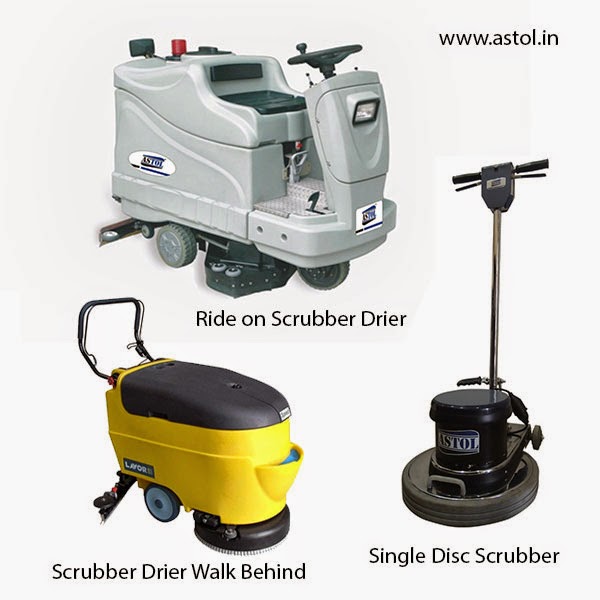
Scrubber Dryers

As the mechanical floor sweeper imitates the action of using a broom; then the scrubber dryer replaces the mop and bucket in the modern workplace. Similar in appearance to the floor sweeper, the floor scrubber uses its brushes to agitate cleaning solution into the floor to remove the dirt and the resulting residue is the collected by a system of squeegees at the rear of the machine. This residue is then vacuumed into a collection tank for later disposal. The floor should be left both clean and dry which means the minimum of disruption to the business. Like the sweeper the scrubber dryer can be a pedestrian or ride-on model.


Scrubber Dryers


Floor Buffers and Polishers

Floor buffers are versatile floor cleaning machines capable of polishing various types of floors including wood or stone and some heavy duty machines are also capable of scarifying concrete floors. The machine pads can be changed to suit the job in hand such as cleaning or polishing.


Floor Buffers and Polishers

Know more to our experts: click here

Sunday, 22 June 2014

Facts of Single Disc Scrubber Machines

Single disc scrubbers are the most versatile, multipurpose and general machines for maintenance and cleaning of all types of floors and carpets. As the name implies, it uses a single rotating disc which works on the floor to clean it. Different pads, rotation speed and motor power can provide the solution for any floor cleaning application: floor cleaning, scrubbing, polishing, marble/granite restoration, crystallization, buffing, spray buffing, scarifying, scouring, sanding, stripping, carpet shampooing, wooden floor sanding etc.


Theoretically, a single disc floor machine is a low speed machine with a horizontally rotating head attached to a large, round scrubbing pad or floor scrubbing brush which spins in a circle in one direction. The spinning of the pad or brush is powered by a small motor, ideally mounted directly over the centre of the machine head to distribute equal pressure on all sides of the brush or pad for proper scrubbing. Most scrubbers come equipped with solution tanks that can squirt floor cleaning solution directly into the scrubbing pad and onto the floor. Scrubbers are made to spin at a variety of speeds. The speed at which the pad or brush rotates directly affects the kind of floor cleaning job to be done.

Single disc scrubbers operate in a side to side or “swing” motion and are designed to handle scrubbing jobs, when the floor has in-ground dirt. Depending upon the accessory chosen, these machines can be used to remove old polishes from worn out floors or grind floors to bring a mirror shine finish on the same floors. Single speed scrubbers usually rotate at output speeds from about 150 to 175 revolutions per minute (RPM). Dual speed scrubbers will go from about 150-350 RPM. With new forms of engineering technologies coming in, many manufacturers have started producing variable or multiple speed floor scrubbers in which the brush/ pad speed can be regulated to suit the floor/ carpet maintenance operation being performed.

Single Disc Scrubbers


Criteria for Selection

The selection of a floor cleaning machine firstly depends upon many factors such as the cleaning operation that needs to be performed, dirt or stain prevalent on the floor, the area to be cleaned, the layout of the area, manoeuvrability of the machine to perform cleaning operations and presence of human traffic during cleaning hours. Usually, where no other machine can be suggested, a single disc scrubber can be the most general purpose machine to be used for any floor cleaning operation. The mechanical action of the floor cleaning process takes into account factors such as motor power, brush speed, brush orientation, weight on the brush and brush aggressiveness. Single disc scrubbers can be evaluated based on the following factors:

  • Motor Power: This defines the strength of the motor to rotate the brush. As the situation becomes more difficult for the brush to rotate, higher should be the power of the motor. For example, for someone doing marble crystallization or dry buffing or carpet shampooing, the friction caused between the floors and pads is higher than the routine floor cleaning operation thereby obstructing the pad to move smoothly. In such circumstances, the motors with higher power will facilitate the pad or brush to rotate despite the resistance provided by the floors. Also, if the operation hours are longer, higher motor power will be more helpful.
  • Brush/ Pad Speed: Every floor or carpet maintenance operation can be optimized with the ideal brush speed of the machine. For those who need to perform multiple operations, there are options of using single speed, 2-speed, 4-speed and variable speed machines.
  • Drive: Usually, the motors rotate at a speed of 1440 RPM, but the brush or pad cannot be allowed to rotate at such high speeds for operator safety. Between the motor and the brush, there is always a speed or motion transmission system, which is usually a gear drive or a belt drive. The more the speed reduction ration, higher is the power transmitted to the machine from the motor. Machines with belt drives are the easiest to design, comparatively cheaper, noiseless and easy to replace. However, since they are not able to produce lower speeds and transmit more power to the brush, they are more suited for easier applications like floor cleaning. For other operations such as carpet shampooing, crystallization, scarifying, marble restoration etc, gear driven machines are most suitable. With gear drives, the speed reduction ratio is higher; therefore the force transmitted to the machine from the motor through the gear drive is higher. Gear drives can also be of different types and planetary gear drives are known to transmit maximum power to the machine.
  • Brush size: If the area to be cleaned is too large, a smaller brush will take too long for cleaning and will render the cleaning job highly inefficient and time consuming. It will be a waste of the labour and money. Therefore, selecting the machine with the right brush size is most important. Most machines are available in 12”, 15” 17” and 20”. It is suggested that machine should be chosen of such a size which would support floor pads which are of fixed sizes as well.
  • Weight and stability: Although single discs require operator skills to balance rather than lift it, weight still plays a crucial role for the machines. Brush pressure is important as the right kind of pressure applied on the brush or pad can optimize the cleaning result. Machine weights should be kept as low as possible without compensating the application. Higher weights can cause operator fatigue when working for longer hours. For carpet shampooing for example, higher weights are not advisable as the extra weights may not let the pile of carpets stand up. But when grinding needs to be performed on the floors, with higher weight, the grinding results will be faster, better and more uniform. If the motor is mounted on the centre of the base of the machine right above the centre of the brush, then the pressure distributed on the base will be equal on all sides. This will help in uniform cleaning, polishing and grinding results and better stability of the machine thereby causing lesser fatigue to the operator.
  • Vibration: At higher weights or higher speeds also, the machine should be stable and should not cause vibrations. The machine operator could benefit from a lower level of vibrations – enabling the machine to be used for longer periods with minimum operator fatigue.
  • Noise: Many single disc cleaners also enable the cleaning process to blend more into everyday working practices by offering a far lower noise option than many other types of floor cleaning machines. This ensures that floor cleaning tasks are able to be undertaken during working hours with minimal disruption to the surrounding workforce and therefore reducing the cost of the machine operators’ overtime or out of hours allowance.
  • Accessories available for use with the machine: The machine should be compatible with all types of accessories so that it can be used for various applications. Except for the pads, most brushes for the machines are to be supplied by the manufacturer of the machine itself. Therefore, it should be checked first as to what are the accessories that will be provided with the machine and optionally.
  • Availability of spares and services from the supplier: Spares and services should be readily available, as longer down times for the machines means loss of revenues to the service providers. Doing a background check for availability and cost of spares will always be helpful in the smooth operations of the machines in years to come.
  • Reputation of the manufacturer: Every manufacturer in the market has certain products which are their core strengths and some products that are only to complement their product portfolio to make it an all round package. But if they are not known to supply some machines with the same quality they are usually associated with, their single disc scrubbers can be avoided.

See more: http://www.astol.in/

Monday, 16 June 2014

Regular Upholstery Cleaning for Health

Junior just spilled his grape soda on the couch and you're wondering why on earth you didn't go with the multi-colored upholstery that looked enough like that spill that no one could tell that it was there. Or, perhaps, you're realizing that your crazy aunt was right to put plastic over everything. Don't worry. Upholstery cleaning is inexpensive and an often neglected part of general home maintenance. It is something you should be doing with regularity, in fact, not just when there is an impossible stain.

Upholstery and Your Family: Be Clean, Be Beautiful


Every day, you and your family come in from outside and go immediately to the furniture. Often, it's snowing or raining, or your kid has come home from a sweaty soccer game or cheerleading practice, or maybe you've spent all day at the office surrounded by other people. Over time, germs, dirt, sweat - everything from ticks to swine flu - will build up on your upholstery Many people do not get their upholstery cleaned nearly enough, if at all. Basic home care should include upholstery cleaning at least once a year. It will contribute not only to the health of your home but its beauty as well.

Upholstery and Carpet Stains: Random Spills

If it isn't time for your yearly upholstery cleaning and there is a spill, you will naturally try to clean something yourself before calling in the cleaning professionals. The best method is preemptive—always ask the carpet store or furniture maker how to best clean the product while still at the store. Often you will find that you get information that is helpful but might not have been disclosed. Armed with this, you can purchase furniture that will stay cleaner longer, last longer, and you will know how to deal with problems as they arise. This also protects you from warranty problems, because some manufacturers even have specific cleaners that you can't use without discrediting any warranty or claim.

Professional Upholstery and Carpet Cleaning Services
Often, you will not be able to get a stain out. Your detergents and cleaning products might not have worked, but that does not mean that a professional cleaning service won't be able to do it for you.

Wednesday, 11 June 2014

Pressure Washing Techniques For a Deep Clean

While the success of many household cleaning tasks simply depends on choosing the right cleanser for the job, there are some cases where the labor involved in removing a film or stain is just too much. Perhaps the stain is bound too tightly to the surface of what you want to clean, or the affected area is simply too large for vigorous hand scrubbing to be a viable option. If this scenario sounds familiar, your solution might require a bit more power.

Common Pressure Washing Situations
You may have seen professionals pressure washing, or maybe even done it yourself. For handling enormous cleaning tasks like buildings, walls, parking areas, heavy equipment, or even statues, a pressure washer is often the right tool for the job. Pressure washing is the preferred cleaning method for removing pollution and fuel emission residue on structures in urban areas. It is also an excellent method of removing mineral, lime, and hard water deposits. Homeowners, especially those who like to work on their own cars, will find that pressure washing is great for grease and oil stains in the garage or driveway; it can even remove graffiti!
DIY vs. Professional Pressure Washing
There is most likely a home improvement center or hardware store in you area that will rent you a pressure washer (or at least point you in the right direction to find someone who will). Make sure that you talk to the people you rent the machine from about the task you plan to use the power washer for to see if they have any advice about technique or particular cleaning solutions you can add to make the operation go smoother.
In professional hands, this is an efficient, effective cleaning alternative that will often save money over more labor-intensive methods. If you've never used a pressure washer before and are unsure of how they work, you may consider hiring a professional for the job. Because of the amount of power involved in pressure washing, an inexperienced user can unintentionally cause a great deal of damage. Situations like cleaning windows or siding with a powerwasher require a delicate and skilled hand, so even if you are confident in cleaning stains from concrete in your driveway, you might consider hiring someone for these kinds of jobs.
Powerwashing Techniques
Power or high-pressure cleaning is a directed blast of internally heated water, often discharged at five gallons per minute, under up to 3,000 pounds per square inch of pressure. For specific cleaning and stain removals, certain chemicals or solvents are added. For specific or environmentally safe cleaning needs, there are several other blasting methods:
With soda blasting, there are the advantages of being environmentally safe, and no pre-masking is required. It cleans multi-layered surfaces, and it is non-corrosive and safe to perform around food equipment.
Sandblasting is intended for jobs that require some stripping and abrasion.
Dry ice blasting shoots dense dry ice pellets that turn to a harmless gaseous substance on impact. This option leaves an instantly dry surface, and it is also safe around food equipment.